Controlling Philips Hue Lights From KNX With ISE Smart Connect KNX Hue

Controlling Philips Hue Lights From KNX With ISE Smart Connect KNX Hue
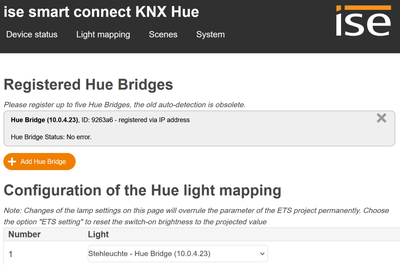
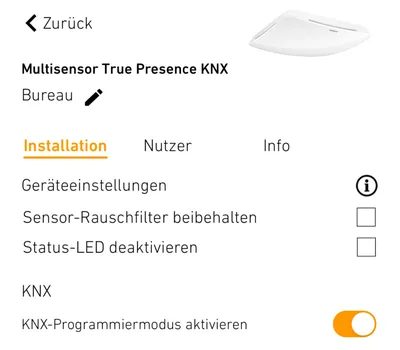
The ISE Smart Connect KNX Hue is a nifty little device that bridges the gap between the KNX and Hue universes. But why bring wireless Hue lights into the mix if you already have lights controlled via wired KNX/DALI? The answer is simple: even in the most well-planned house there are situations where you want to place lights in positions where only a plain socket without KNX or DALI control is available. In such cases, wirelessly controlled Hue bulbs are a flexible solution. However, you still want to be able to control all your lights - KNX, DALI, and Hue - from one place: your KNX room controllers. The ISE Smart Connect KNX Hue enables just that.
KNX & ETS

Docker (Compose) Cheat Sheet

Docker (Compose) Cheat Sheet
This is a collection of tips and tricks I picked up while learning and working with Docker and Docker Compose on my home server and web server. Container Configuration Environment Variables Where to Define Environment Variables Environment variables are a common way to configure containers. To keep things organized, don’t put them in your Compose file but into dedicated files with the extension env. env_file vs. .env .env file: this “special” file can be used to set environment variable for use in the Compose file. The variables specified in .env are not available in the container. env_file: this section in the Docker Compose file lets you specify files that contain environment variables for use in the container. The variables specified in this section are not available in the Compose file. Bind Mounts vs. Docker Volumes Bind mounts let you control the directory structure. This has the advantage that you know exactly what gets stored where in the host’s file system. It has the disadvantage that you need to create the directory structure before you can start a container. Docker volumes are managed by the Docker engine. They’re stored in /var/lib/docker, “far away” from the Compose file. Personally, I very much prefer bind mounts because of the control they offer. I use subdirectories relative to the Compose file, e.g., ./data:/data. Keeping the container configuration and the container data in one place facilitates backups. Networking Expose vs. Ports Expose serves as documentation which ports a container is accessible on. Note: container ports are always accessible from other containers on the same Docker network. Ports makes container ports accessible to the host. Most of my services are accessible through the Caddy reverse proxy only. Opening ports to the host is, therefore, only rarely necessary. Static IP Address on the Host Network Use the Macvlan Docker network to attach a container directly to the host’s local network. Assign a static IP address by specifying the ip_range parameter in the ipam section of the Docker Compose file. See this configuration for an example. Disable Macvlan Container/Host Isolation Containers on a Macvlan network are isolated from the host. While the container can contact other machines on the local network, communications with the host are blocked. To work around that, create a virtual link with a route that points to the container’s IP address (example). Time Zone Containers should know about your local time zone. To achieve that, make it a habit to pass in /etc/localtime as a read-only volume to every container:
Virtualization & Containers

Obsidian: Getting Started With the Markdown Note-Taking App

Obsidian: Getting Started With the Markdown Note-Taking App
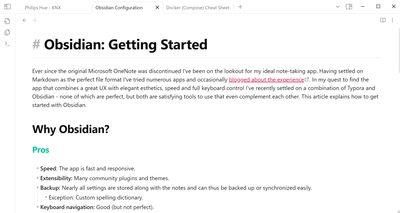
Ever since the original Microsoft OneNote was discontinued I’ve been on the lookout for my ideal note-taking app. Having settled on Markdown as the perfect file format I’ve tried numerous apps and occasionally blogged about the experience. In my quest to find the app that combines a great UX with elegant esthetics, speed and full keyboard control I’ve recently settled on a combination of Typora and Obsidian - none of which are perfect, but both are satisfying tools to use and they even complement each other. This article explains how to get started with Obsidian.
Applications

VictoriaMetrics: Long-Term Storage of Home Assistant Data

VictoriaMetrics: Long-Term Storage of Home Assistant Data
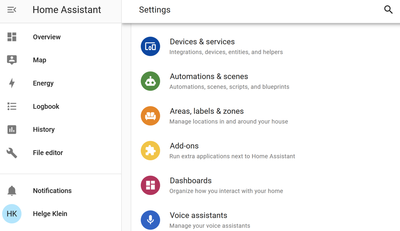
This article explains how to set up VictoriaMetrics in a Docker container with automatic HTTPS via Caddy. It also shows how to forward Home Assistant data to VictoriaMetrics for long-term storage and how to query the data from Grafana. This post is part of my series on home automation, networking & self-hosting that shows how to install, configure, and run a home server & network with dockerized or virtualized services.
Home Automation, Networking & Self-Hosting

Ploopy Adept - Ergonomic Trackball With Hyperscrolling

Ploopy Adept - Ergonomic Trackball With Hyperscrolling
If you’re plagued by RSI symptoms, it’s high time you evaluate alternatives to traditional keyboards and mice. For me, moving the mouse to my left hand nearly twenty years ago (even though I’m not left-handed) seemed to do the trick. Ultimately, though, it proved not to be enough. Much later I switched to a lightweight gaming mouse to reduce the weight I’d have to lug around. That helped, but only for a time. I also experimented with various types of split keyboards. But that’s a topic for another post.
Hardware

Simple OPNsense Firewall Rules for a Secure Smart Home

Simple OPNsense Firewall Rules for a Secure Smart Home
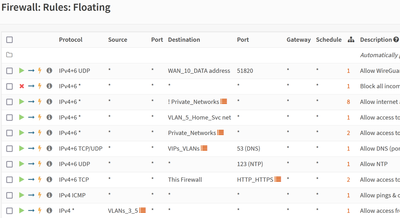
This article presents a simple, balanced OPNsense firewall configuration for a secure smart home. The config provides good security while still allowing the freedom that is required by a family that is comprised mostly of people who wouldn’t call themselves IT geeks. This post is part of my series on home automation, networking & self-hosting that shows how to install, configure, and run a home server & network with dockerized or virtualized services.
Home Automation, Networking & Self-Hosting

Samba File Server: Web Access Through Filebrowser With SSO & HTTPS

Samba File Server: Web Access Through Filebrowser With SSO & HTTPS
This article explains how to set up Filebrowser in a Docker container as a web interface for browser-based access to a Samba file server. Please note that in my own use this configuration has been superseded by a Filestash setup which has the advantage of accessing the storage as the authenticating user. Filebrowser and other tools like it have the disadvantage of accessing the file system through one “service” user account. This means that what the browser shows is not what the actual user is allowed to access but instead what the service account has permission to read. Also, when files are created, the owning user is the service account. This post is part of my series on home automation, networking & self-hosting that shows how to install, configure, and run a home server with dockerized or virtualized services. This article is part of a mini-series about running Samba Active Directory and a file server service in a Docker container on a home server:
Home Automation, Networking & Self-Hosting