VMware Horizon in a Lab: Getting Rid of SSL Errors

This is a description of a quick and dirty way to get SSL to work correctly in a VMware Horizon View installation in a lab environment. Do not do this in production!

The Situation

The Horizon View Connection Server installer creates a self-signed certificate which it places in the computer’s personal certificate store. This certificate’s root is not trusted by anyone, least of all by the clients trying to connect to your apps and desktops.

Establishing Trust

To make the default self-signed certificate work correctly you need to export it from the computer’s personal certificate store and then re-import it in the trusted root certificate store.

Exporting
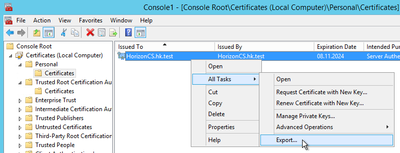
Exporting VMware Horizon self-signed certificate

It is OK to export without a private key; leave the file format at the default.

Importing - Connection Server

When re-importing the key on the Horizon View Connection Server manually select the computer’s Trusted Root Certification Authorities store:
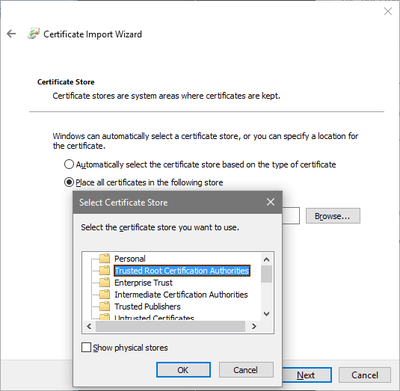
Importing VMware Horizon self-signed certificate as root certificate

After the import restart the Connection Server machine. View Administrator should now display the Connection Server status in green (certificate valid):
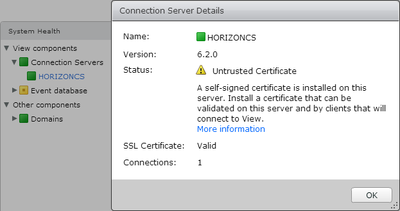
VMware Horizon Connection Server details

Importing - Clients

Clients that connect to Horizon need the certificate imported as trusted root certificate in the same way as described for the Connection Server above.

Name Resolution

Clients connecting to Horizon View need to be able to resolve the name as it is stored in the certificate, in all likelihood fully qualified. If your (lab) clients use a different DNS server than the Horizon installation the simplest solution is to add the Connection Server’s name and IP address to each client’s hosts file.
Comments

Related Posts

Citrix XenApp 7.6 Logon Slow - Long Black Screen Phase

Citrix XenApp 7.6 Logon Slow - Long Black Screen Phase
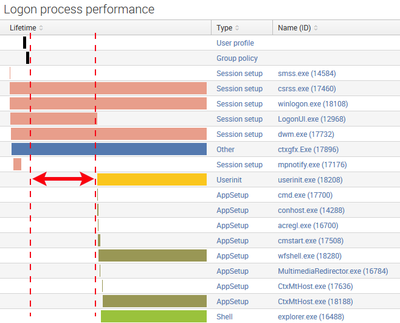
Update 2015-04-28: Citrix provides the limited release hotfix ICATS760WX64009 that fixes this issue. More information below. During the research for my session about the XenApp 7.6 logon process, to be presented at Citrix Synergy and BriForum London, I noticed that the logon to my XenApp 7.6 lab server was taking a bit long. Longer, in fact, than the combined durations of the main logon phases user profile loading, group policy processing, logon script execution and shell startup. Much longer. Also much longer than on an otherwise similar XenApp 6.5 machine.
Citrix/Terminal Services/Remote Desktop Services

Latest Posts

Fast & Silent 5 Watt PC: Minimizing Idle Power Usage

Fast & Silent 5 Watt PC: Minimizing Idle Power Usage
This micro-series explains how to turn the Lenovo ThinkCentre M90t Gen 6 into a smart workstation that consumes only 5 Watts when idle but reaches top Cinebench scores while staying almost imperceptibly silent. In the first post, I showed how to silence the machine by replacing and adding to Lenovo’s CPU cooler. In this second post, I’m listing the exact configuration that achieves the lofty goal of combining minimal idle power consumption with top Cinebench scores.
Hardware

Fast & Silent 5 Watt PC: Lenovo ThinkCentre M90t Modding

Fast & Silent 5 Watt PC: Lenovo ThinkCentre M90t Modding
This micro-series explains how to turn the Lenovo ThinkCentre M90t Gen 6 into a smart workstation that consumes only 5 Watts when idle but reaches top Cinebench scores while staying almost imperceptibly silent. In this first post, I’m showing how to silence the machine by replacing and adding to Lenovo’s CPU cooler. In a second post, I’m listing the exact configuration that achieves the lofty goal of combining minimal idle power consumption with top Cinebench scores.
Hardware