Installing ESXi 4.1 on HP DL380 G8: No NICs Found

This kept us occupied quite a bit: after having worked with HP’s G7 line of servers for a long time, we ordered our first DL380 G8 for use with VDI. According to HP’s documentation the same custom image can (and must be) used when installing ESXi as with the G7. With that information, setting up the G8 sounded like an easy job: provision it via the existing automation mechanism and be done.

Problem

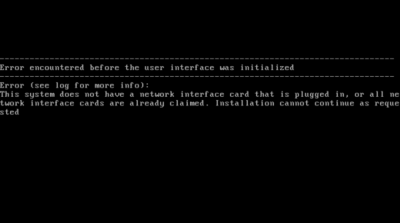
At first, everything went smoothly: the server booted from the network, loaded the install files and ran the first phase of the ESXi setup. Then it rebooted from its hard disk and continued with stage 2, happily loading the VMKernel - which displays the yellow screen. When the driver loading phase was over, the trouble started. We got this screen:
VMware ESXi install error on HP DL380 G8

The error message is:

------------------------------------------------------------------------------
Error encountered before the user interface was initialized
------------------------------------------------------------------------------
Error (see log for more info):
This system does not have a network interface card that is plugged in, or all
network interface cards are already claimed. Installation cannot continue
as requested.

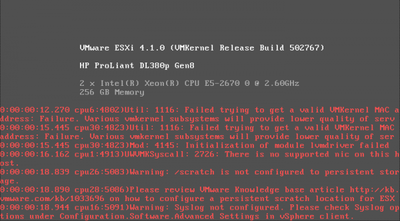
Switching to the log screen with ALT+F12 gave us this:
DL380 G8 installation error with VMware ESXi 4.1

The relevant message is:

There is no supported nic on this host.

The message is nearly funny - the server had just booted from the network.

Solution

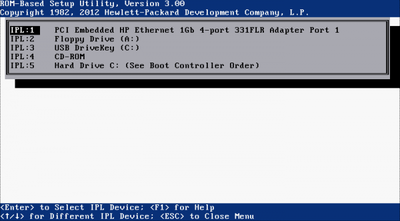
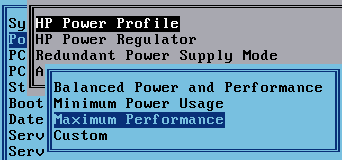
I will spare you the details of our bug hunt. Suffice to say, it resembled a wild goose chase that even involved HP Support. In the end we found out that it is the boot device order. It works like this:
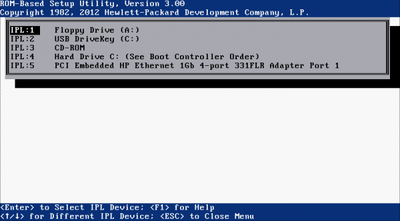
BIOS - works 1

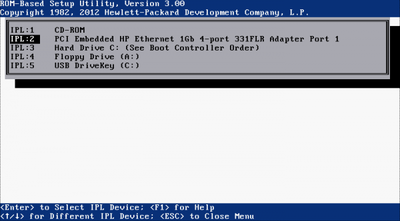
…does not work like this:

BIOS - broken 1

…does not work like this:

BIOS - broken 2

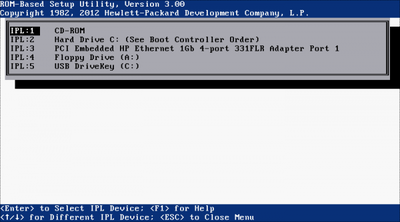
…and works like this:

BIOS - works 2

Did you notice a pattern? Sure you did. If the network card is higher up in the boot order than the hard disk, the error occurs.

Remedy (a Week Later)

After we had opened a support call with HP a technician turned up and replaced both mainboard and NIC. After that, the error was gone. Unfortunately he could not say what might have been the cause.
Comments

Related Posts

Windows Server 2019 on Hetzner's EX62 & AX100 Dedicated Servers

Windows Server 2019 on Hetzner's EX62 & AX100 Dedicated Servers
This post is a follow-up to my 2016 article on how to install Windows Server on Hetzner’s EX51 hosted dedicated servers. Hetzner offers many types of dedicated servers at very attractive prices and - astonishingly - good support. This article lists some issues we encountered while installing Windows Server 2019 on the EX62 and AX100 servers and how we worked around them. Reading the earlier article is highly recommended.
Virtualization & Containers

Is VMware Clustering / VMotion Complex Compared to Microsoft Failover Clustering?

My last post on VMware VMotion urged several readers to protest, maybe because of its provocative title. What I did was to compare VMware clustering with Microsoft failover clustering. I got to the conclusion that both significantly add to the complexity of the environment. Interestingly, most commenters said, yes, Microsoft clustering is complex, but no, VMware clustering is not, yet failed to explain exactly why.
Virtualization & Containers

Latest Posts

Fast & Silent 5 Watt PC: Minimizing Idle Power Usage

Fast & Silent 5 Watt PC: Minimizing Idle Power Usage
This micro-series explains how to turn the Lenovo ThinkCentre M90t Gen 6 into a smart workstation that consumes only 5 Watts when idle but reaches top Cinebench scores while staying almost imperceptibly silent. In the first post, I showed how to silence the machine by replacing and adding to Lenovo’s CPU cooler. In this second post, I’m listing the exact configuration that achieves the lofty goal of combining minimal idle power consumption with top Cinebench scores.
Hardware

Fast & Silent 5 Watt PC: Lenovo ThinkCentre M90t Modding

Fast & Silent 5 Watt PC: Lenovo ThinkCentre M90t Modding
This micro-series explains how to turn the Lenovo ThinkCentre M90t Gen 6 into a smart workstation that consumes only 5 Watts when idle but reaches top Cinebench scores while staying almost imperceptibly silent. In this first post, I’m showing how to silence the machine by replacing and adding to Lenovo’s CPU cooler. In a second post, I’m listing the exact configuration that achieves the lofty goal of combining minimal idle power consumption with top Cinebench scores.
Hardware