DiskLED is Now Open Source

DiskLED is a tool I wrote a while ago that displays performance counter data using an animated system tray icon. It comes with a graphical configuration dialog that lets you choose from all performance counters available on the local system – you can monitor network throughput just as easily as hard disk activity or memory usage.
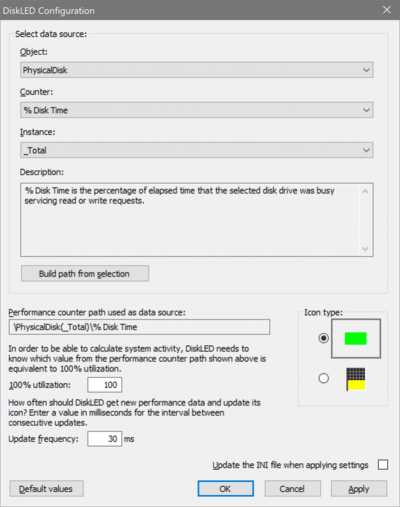
There still seems to be a decent userbase - after all, DiskLED works on Windows 10 just as well as it did on XP. I sometimes get requests for new features or modifications. Unfortunately, I do not have the time for that. But I am more than happy to comply with Brian H’s request to make DiskLED open source.

You can find DiskLED’s source code on GitHub. Have fun!

Comments

Related Posts

Free Tool: Refresh the Desktop Programmatically

I recently had the requirement to refresh the Windows desktop after certain changes had been made to Explorer’s registry entries. This seems simple at first: klick on any item on the desktop and then press F5. It wasn’t, though. The registry changes would be made upon logon by a software installation agent. It was expected by the customer that the end user see the the effects of the change immediately without any user intervention. That sent me hunting for a solution on the internet. I came across many forum posts that showed that many others already had exactly the same requirement. Interestingly, none of the proposed solutions actually worked. Except for one, which I found at last.
Helge's Tools

Free Tool - List Registry Links (REG_LINK)

Recently I got into a very interesting discussion with my colleague Nicholas Dille on various aspects of Windows x64. One question he brought up was especially intriguing: knowing about registry redirection, it is not astonishing to find that the 32-bit version of the registry key HKLM\Software\Classes (aka HKCR) gets to be HKLM\Software\Classes\Wow6432Node. But there is also HKLM\Software\Wow6432Node\Classes!? How can there be two different Wow6432Node 32-bit keys for one 64-bit key?
Helge's Tools

Latest Posts

Fast & Silent 5 Watt PC: Minimizing Idle Power Usage

Fast & Silent 5 Watt PC: Minimizing Idle Power Usage
This micro-series explains how to turn the Lenovo ThinkCentre M90t Gen 6 into a smart workstation that consumes only 5 Watts when idle but reaches top Cinebench scores while staying almost imperceptibly silent. In the first post, I showed how to silence the machine by replacing and adding to Lenovo’s CPU cooler. In this second post, I’m listing the exact configuration that achieves the lofty goal of combining minimal idle power consumption with top Cinebench scores.
Hardware

Fast & Silent 5 Watt PC: Lenovo ThinkCentre M90t Modding

Fast & Silent 5 Watt PC: Lenovo ThinkCentre M90t Modding
This micro-series explains how to turn the Lenovo ThinkCentre M90t Gen 6 into a smart workstation that consumes only 5 Watts when idle but reaches top Cinebench scores while staying almost imperceptibly silent. In this first post, I’m showing how to silence the machine by replacing and adding to Lenovo’s CPU cooler. In a second post, I’m listing the exact configuration that achieves the lofty goal of combining minimal idle power consumption with top Cinebench scores.
Hardware