AppLocker - Security Problems

  • Security
  • Published Aug 7, 2012 Updated Aug 6, 2012

This article is part of my small series about AppLocker, a technology built into Windows that enables administrators to audit and optionally block application execution.

AppLocker Security

There is no perfect security, every product has its vulnerabilities and AppLocker is no exception. These are the problems I am aware of.

Windows\Temp

AppLocker’s default rules allow the execution of all code from the Windows directory. This is generally considered safe, since standard users do not have permissions to write to C:\Windows and its subdirectories. However, there is one exception: users have write and execute permissions in C:\Windows\Temp by default as the following screenshot from SetACL Studio shows:
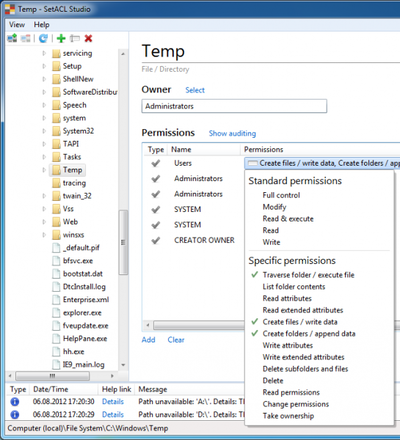
Permissions on C-Windows-Temp

To close this loophole modify the default AppLocker rule so that it contains an exception for C:\Windows\Temp.

VBA and SANDBOX_INERT

A non-blocked process can start arbitrary executables circumventing AppLocker’s rules by calling the API function CreateRestrictedToken with the parameter SANDBOX_INERT. This is a problem because Microsoft Office will not be blocked in most if not all enterprises, and Office’s scripting language Visual Basic for Applications is well capable of calling API functions.

More information and a test program is available in Didier Steven’s blog.
Comments

Related Posts

AppLocker - Solutions to Common Problems

AppLocker - Solutions to Common Problems
This article is part of my small series about AppLocker, a technology built into Windows that enables administrators to audit and optionally block application execution. AppLocker and UAC One of the default rules allows unrestricted application execution for administrators. That is only sensible. After all, someone needs to be able to troubleshoot and perform maintenance. However, if UAC is enabled, that rule is not very useful. Remember: UAC filters the SID for the group Administrators from the access token during normal operation. With the Administrators’ SID gone, AppLocker is active for administrators in the same way it is for all other users. Administrators wishing to bypass AppLocker need to start executables from an elevated command prompt (or right-click and select run as administrator), which is often impractical.
Security

Finding (Executables in) User-Writeable Directories

Finding (Executables in) User-Writeable Directories
This article presents two different detection types for insecure filesystem permissions on Windows endpoints: scanning for directories that are user-writable, and detecting processes that are started from user-writeable directories. Directory Scan With ListUserWriteableDirectories & SetACL My ListUserWriteableDirectories script is an implementation of the first detection type: it scans the filesystem listing any permissions not known to be safe.
Security

Latest Posts