64 Bit: The Final Frontier – Slides From my Presentation at PubForum

Only a few days ago I attended PubForum in Frankfurt - a weekend well spent! I had an altogether good time and very much enjoyed meeting so many great people. I also presented on the topic of migrating to 64-bit Windows Server 2008 R2 and XenApp 6, a task not to be taken lightly. For anyone interested, here is the slide deck I used.
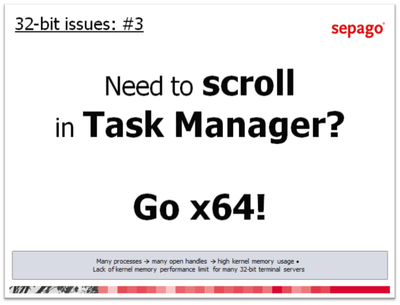
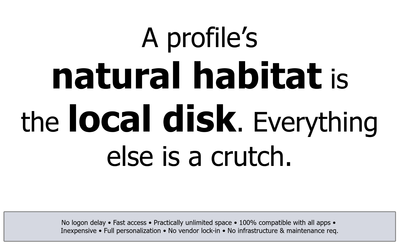
Helge Klein - x64 - Final frontier - 1

Download the slide deck here.

Comments

Related Posts

Where is the Hosts File on Windows x64?

[A German translation of this article is available at faq-o-matic.net.] The subtle differences between 32-bit and 64-bit Windows present so many intricacies and pitfalls that even Microsoft employees seem to have trouble getting it right. I just stumbled upon a KB article that describes how to reset the hosts file to its original state. The topic alone is funny enough - it is not as if the default hosts file contained great amounts of data. An entry for localhost (IPv4 and IPv6) is all you need, and on Windows 7 / Server 2008 R2 not even that. But anyhow, there seem to be enough people asking MS support for this or they would not have troubled with creating a package (ResetHOSTSFileBackToDefaults.MSI) that basically empties the hosts file.
64-Bit Windows (x64)

.NET Applications on Windows x64 - Easy? Yes and No

When migrating to 64-bit Windows, traditional “unmanaged” applications can pose challenges. That is because unmanaged binaries contain hardware-dependent CPU instructions - and the view on the hardware differs between 32- and 64-bit mode. But .NET? It should be unaffected of a system’s bitness since “managed” binaries contain instructions in a so-called intermediate language that is executed in a virtual machine at run-time and only then translated to machine language. But is it really? This article is about .NET programs that are dependent on OS bitness.
64-Bit Windows (x64)

Latest Posts