Guide: WordPress on Dockerized Apache on Hetzner Cloud

Guide: WordPress on Dockerized Apache on Hetzner Cloud
If you’ve followed this blog for a while, you may have noticed that I’ve used a traditionally installed (i.e., not dockerized) LAMP stack for its server setup since 2014. Only recently did I switch to Docker containers. Why? Maintenance. Much facilitated maintenance. If you take a look at the articles I’ve written over the years describing how to upgrade to newer versions of Ubuntu or - god beware - PHP, you can’t help but realize what a godawful PITA it all is. Switching to Docker enforces (or at least strongly encourages) a strict separation of (public) code and (personal) configuration. With this new setup, upgrading from one PHP version to another involves nothing more than changing a version number in a text file.
Website

Switching from Chrome to Firefox

Switching from Chrome to Firefox
After many years as a happy user, I switched from Chrome to Firefox. How did that go? Astonishingly well! Here are some notes I took in the process. My History of Changing Browsers Netscape to Internet Explorer I think I started out with Netscape Navigator on Windows 95. My first change of browsers happened with Windows NT 4 and Internet Explorer 4. That was a great browser! Everybody switched to IE in the following years. Microsoft’s domination of the browser market (yes, that was a reality for many years) started right there with IE4. Internet Explorer was successful not only because it was bundled with the operating system, but also because it was a good application.
Applications

Converting Mercurial Repositories to Git on Windows

Converting Mercurial Repositories to Git on Windows
If you work with text, you need version control. That rule applies regardless of whether you write code or poetry (some might argue that those two are the same, anyway). Ignoring the CVS and SVN dinosaurs two distributed version control systems are being regarded as state of the art: Git and Mercurial. Functionality-wise they are nearly identical, but it seems that Git, with its open-source background, is poised to take over the enterprise, too, where Mercurial used to be strongest.
Software development

The Making of HelgeKlein.com, SetACL's New Home

The Making of HelgeKlein.com, SetACL's New Home
Until yesterday, SetACL’s web presence consisted of six static HTML pages. That was great for speed, but it sucked in almost every other aspect. And the design … better not speak about that. The old website was hosted on Sourceforge, on the subdomain setacl.sourceforge.net, to be exact. High time for a radical change. I wanted a good clean design, interactivity (commenting), easy maintenance and my own domain. And I wanted a place where I could assemble and store all the relevant content I publish on the web, namely blog articles and tweets. This is the story of the creation of that place.
Website

Free Script: User Profile Domain Migration with SetACL

This article is part of Helge’s Profile Toolkit, a set of posts explaining the knowledge and tools required to tame Windows user profiles. When administrators migrate user accounts between domains, they typically re-ACL those server resources users have access to. In plain English: they copy or move the permissions from the accounts of the old domain to the corresponding accounts of the new domain. There are various ways to do that. In this article, I present a simple way to re-ACL roaming user profiles.
User Profiles

Migrating from Blogger to Custom Domain on Wordpress Without Losing PageRank

Migrating from Blogger to Custom Domain on Wordpress Without Losing PageRank
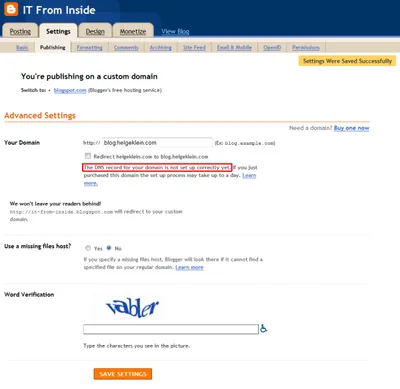
Migrating a blog can be a very painful process, part of which stems from the fact that, if not done correctly, search engine valuation (aka PageRank) that took years to gain may be lost in days. Redirecting from the old blog to the new URL alleviates this problem at least, but not the way it is described on countless websites that recommend implementing JavaScript redirects search engines do not care about. Instead HTTP 301 redirects are needed which unfortunately required access to the .htaccess file on the web server hosting the old blog to set up. And you may have guessed already - Blogger.com does not grant that type of access.
Website

New OS = New Profile = User State Lost. True or False?

New OS = New Profile = User State Lost. True or False?
Going to Windows 7 or Server 2008 (R2) means trouble. Let me use an analogy to explain why. You are in charge of moving people from their old houses to shiny new buildings. You have planned everything perfectly. The new homes are beautiful and located in a great neighborhood. But still, after moving house, people start to complain. They do not feel at home. You forgot to take all those seemingly unimportant things that make a house a home: pictures, plants, all sorts of personal stuff. Impossible, you say? People would never leave their personal belongings behind? I agree: when it comes to moving house, not taking at least most of the personal stuff is highly unlikely. But in IT it is common practice.
User Profiles