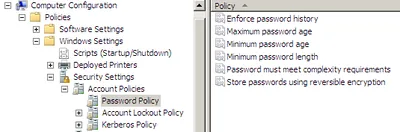
How Forcing Password Changes Actually Weakens Security

How Forcing Password Changes Actually Weakens Security
When was the last time you got that not too friendly message stating that your password has expired and asking you to change it? Probably only a few weeks ago, and just as sure as day follows night, it is going to appear again only too soon. At least that is the typical user’s point of view. Security conscious administrators see this differently: they seem to think that passwords become weaker over time, like human beings growing old, and therefore force a rejuvenation process every couple of weeks. But is that really necessary? I do not think so.
Security

Four Ways to Increase the Capacity of Your Citrix XenApp Farm

Even with the most meticulous design, the day will come when your farm’s capacity is not sufficient any more. User numbers increase, applications become more resource-hungry and the amount of data to be handled increases steadily. So what do you do? Simply more of the same, i.e. buy more servers and add them to the farm? That is one way of increasing capacity, but it is not the only one and therefore may not be the best.
Performance/Sizing

Where is the Hosts File on Windows x64?

[A German translation of this article is available at faq-o-matic.net.] The subtle differences between 32-bit and 64-bit Windows present so many intricacies and pitfalls that even Microsoft employees seem to have trouble getting it right. I just stumbled upon a KB article that describes how to reset the hosts file to its original state. The topic alone is funny enough - it is not as if the default hosts file contained great amounts of data. An entry for localhost (IPv4 and IPv6) is all you need, and on Windows 7 / Server 2008 R2 not even that. But anyhow, there seem to be enough people asking MS support for this or they would not have troubled with creating a package (ResetHOSTSFileBackToDefaults.MSI) that basically empties the hosts file.
64-Bit Windows (x64)

Folder De-Localization with Citrix User Profile Manager (UPM)

Windows user profiles prior to Vista / Server 2008 contain localized folder names. End users expect that, of course, but admins tend to hate it because automated management becomes much more difficult. How can this dilemma be resolved? End users only see the local copy of the profile, while admins mostly have to deal with the central copy on a file server. Wouldn’t it be cool to have a “translator” component that makes sure local folders are localized while central folders are in one language only?
User Profiles

Cleaning up the Mess Left Behind by Multiple EFS Certificates

In case you have (un?)wittingly been juggling around with multiple EFS certificates like me, you may feel a strong urge to clean up the mess. Which mess? It can happen quite easily that different files are encrypted with different keys. In addition to that, directories that are marked for encryption have EFS certificates associated with them, and there is no UI to manipulate that. In order to straighten this out, once the proper certificate is in place each file and directory needs to be “touched” in order to update their encryption keys.
Tips and Tools

How to Find and List Unsigned Executable Files

Executable files can (and should be!) digitally signed. Without a digital signature you can never be sure the files on your hard disk have not been tampered with. There is really no exception to this rule, except maybe smaller open source projects that lack the budget to buy the digital certificate required for signing. Digitally signing executable files is so important that Microsoft made it a requirement in the Windows 7 Logo Program. One might think that such a simple yet important thing as signed executables can be taken for granted by now. Well, let’s have a look!
Scripting

Is VMware Clustering / VMotion Complex Compared to Microsoft Failover Clustering?

My last post on VMware VMotion urged several readers to protest, maybe because of its provocative title. What I did was to compare VMware clustering with Microsoft failover clustering. I got to the conclusion that both significantly add to the complexity of the environment. Interestingly, most commenters said, yes, Microsoft clustering is complex, but no, VMware clustering is not, yet failed to explain exactly why.
Virtualization & Containers

VMotion Is Hyped by Consultants, But Do Admins Even Use It?

Some time ago I attended a presentation by a former VMware, now Microsoft employee who claimed that Hyper-V’s lack of Live Migration aka VMotion is not relevant at all. According to him, the only people vigorously demanding such a feature are consultants, never customers. At the time I thought: “What a silly marketing number this is. Microsoft does not have it, so they tell everyone that it is not really needed until they have it.”
Virtualization & Containers

User Profile and Home Directory Storage: Distributing the Load Across Multiple File Servers

This article is part of Helge’s Profile Toolkit, a set of posts explaining the knowledge and tools required to tame Windows user profiles. The easiest way to assign user profile and home directories is via group policy. But that can only be done per computer. There is no (simple) way to point different users’ directories to different file servers. So what? No problem at all, until the number of users is too large for a single file server to handle. This article discusses what can be done to spread the user load.
User Profiles