What Remains of Magic Speed Improvements
- Performance/Sizing
- Published Feb 13, 2012 Updated May 3, 2013
Doesn’t every IT pro dream of finding a secret switch, a switch that increases clock speed, doubles the amount of RAM or makes the PC boot faster? Some do, and I admit I was fascinated when I heard that changing a simple boot option would significantly speed up startup time. I made some tests which confirmed what I had heard and blogged about my findings. A lot of people picked up that post, I was happy and everything was great - until I found out I was wrong.
When André from WinVistaSide commented on my article and insisted I was wrong I tested again. To my great shame I have to admit that he is right. Apparently this is a hoax (or put more mildly: a misunderstanding) even IT pros like myself fall for. Thank you, André, for pointing this out.
The Difficulty of Measuring
Measuring is easy, but measuring correctly is very hard. In German, physicists have a saying that illustrates this: “Wer misst, misst Mist.” [Who measures, measures rubbish.]
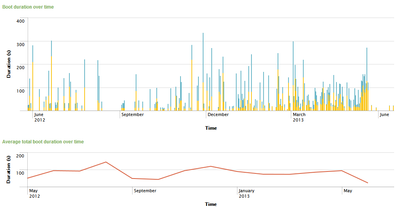
I had measured like this: first I timed the purportedly slow setting, booting twice, if I remember correctly. Then I changed to the “fast” setting and took another two or three measurements while booting. The latter numbers were 20% smaller. Proof the second setting is better? Obviously - if there are no additional external influences.
Instead of stopping here I should have reversed the setting a second time and taken more timings. I would have found that the numbers stay exactly the same. I know, because I did that just now. The “magic setting” has no measureable effect whatsoever.
But wait, there was a speed increase when I first enabled the “magic setting”. Yes, there was, but remember I mentioned external influences earlier? There are other powers at work that change the setup between timings, namely ReadyBoot, Windows’ boot optimization mechanism (here is a nice explanation).
Lessons Learned
Not measuring bullshit is difficult. Numbers lie. People, too, although in many cases unwittingly (as I did in this case). Numbers are used to simplify complex things into a single item. In many cases that is not possible without losing much of the detail and context, and in some cases the resulting number has no meaning at all.





Comments