Fixing IPv6 Intermittent Packet Loss Caused by Windows Firewall

This article shows a simple solution to a weird networking problem that plagued me for hours: IPv6 packets were sometimes lost; IPv4 was not affected.
Problem: IPv6 Ping Timeouts and Packet Losses

Symptom: Teams Issues

I noticed the problem first when there were intermittent connectivity issues in Teams during a meeting.

Ping for Diagnosis

Analyzing the problem later, I found that a simple continuous ping illustrated the symptoms nicely: IPv6 pings would sometimes fail (with request timed out) while IPv4 pings were rock solid.

Ruling out Potential Causes

I first suspected my ISP, until I noticed that other devices weren’t affected. So I focused on the one machine showing the symptoms.

I went through all the usual steps, even uninstalled several older applications and disabled a suspicious network filter driver, all to no avail.

Solution: Restore Defaults of Windows Defender Firewall

If you observe similar symptoms as I described above, test if your root cause is the same as mine by temporarily disabling Windows Firewall. If the issues goes away, proceed. If not you’ll have to look for other potential solutions, I’m afraid.

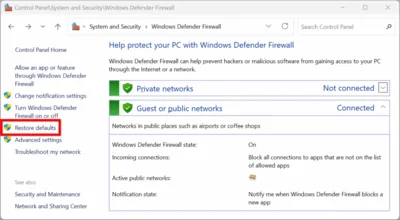
Now on to the actual solution. Open the Windows Defender Firewall control panel applet (firewall.cpl). On the left-hand side you’ll notice a Restore defaults link. Click it. You’ll get a warning that all your firewall rule customizations will be lost.

Take that seriously and pause to think if there’s anything customized in your firewall config.

If you’re sure you don’t need anything from your current firewall setting anymore, go ahead.

That fixed the issues for me immediately.

Comments

Related Posts

Now you can PROVE that it's not Citrix but the backend!

Now you can PROVE that it's not Citrix but the backend!
You have been there: end-users are complaining and your boss demands an explanation why “Citrix is slow” - again. You, the XenApp/XenDesktop admin, desperately look at Task Manager and Perfmon, but you cannot find a thing. Your servers are humming along quite nicely, but still: applications are slow, the system feels sluggish and logons are taking forever. And then, all of a sudden, things are back to normal. What was going on? How do you prevent that from happening again?
Networking

Remote Management of Windows PCs in an Isolated Security Zone

Remote Management of Windows PCs in an Isolated Security Zone
With the advent of BYO it has become fashionable to regard PCs as untrusted devices that should be isolated in a dedicated security zone. Zoning Such an approach has a big advantage: by separating clients from servers it is possible to treat them differently and potentially apply more relaxed security policies - which is a basic requirement for BYO. In a truly BYO-only environment you block everything except Citrix ICA or some other remoting procotol of choice at the firewall and life is good. In real corporate networks things are a bit more complicated, however. Say you want to isolate your managed Windows PCs. In that case you might want to be able to manage them remotely from systems outside the client security zone (e.g. from management terminal servers). And suddenly you have a problem: Windows management protocols, especially RPC and DCOM, are not exactly firewall-friendly.
Security

Latest Posts

Fast & Silent 5 Watt PC: Minimizing Idle Power Usage

Fast & Silent 5 Watt PC: Minimizing Idle Power Usage
This micro-series explains how to turn the Lenovo ThinkCentre M90t Gen 6 into a smart workstation that consumes only 5 Watts when idle but reaches top Cinebench scores while staying almost imperceptibly silent. In the first post, I showed how to silence the machine by replacing and adding to Lenovo’s CPU cooler. In this second post, I’m listing the exact configuration that achieves the lofty goal of combining minimal idle power consumption with top Cinebench scores.
Hardware

Fast & Silent 5 Watt PC: Lenovo ThinkCentre M90t Modding

Fast & Silent 5 Watt PC: Lenovo ThinkCentre M90t Modding
This micro-series explains how to turn the Lenovo ThinkCentre M90t Gen 6 into a smart workstation that consumes only 5 Watts when idle but reaches top Cinebench scores while staying almost imperceptibly silent. In this first post, I’m showing how to silence the machine by replacing and adding to Lenovo’s CPU cooler. In a second post, I’m listing the exact configuration that achieves the lofty goal of combining minimal idle power consumption with top Cinebench scores.
Hardware